

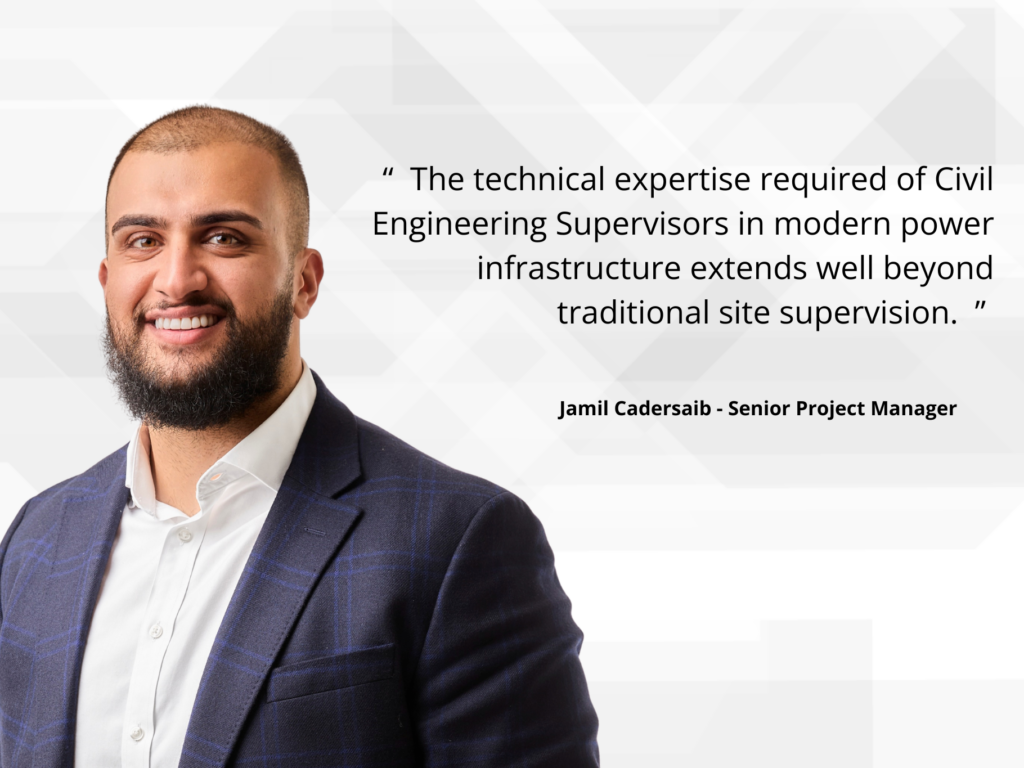
Jamil Cadersaib is a skilled project manager who leads multi‑disciplinary teams to deliver sustainable, low‑risk engineering solutions. With experience across Civil and Electrical engineering from 11kV to 400kV, he specialises in feasibility studies, optimal cable routing, and guiding stakeholders through clear optioneering to achieve the most effective project strategy.
The rapid growth of renewable energy, Battery Energy Storage Systems (BESS), data centres, and electrification projects is fundamentally reshaping power infrastructure delivery. As projects become more complex and are delivered in increasingly constrained environments, the technical expectations placed on Civil Engineering Supervisors have expanded significantly.
Industry context
Power infrastructure projects are being delivered under heightened regulatory scrutiny, tighter programme constraints, and increasing technical interdependencies between civil, electrical, and environmental systems. Civil Engineering Supervisors are no longer solely responsible for overseeing construction activities; they are now expected to provide informed technical leadership throughout the project lifecycle, from early feasibility through construction and commissioning.
Core civil engineering competence
At the foundation of the role lies strong technical knowledge in civil engineering principles. This includes expertise in the utilities industry, temporary works, structural interfaces, surface reinstatement, and street works compliance. In power infrastructure projects, supervisors must also understand trenching and trenchless methodologies, duct and joint bay design, and access road construction. Additionally, they need to keep up to date with new laws and regulations posed by statutory bodies and local authorities, including health and safety legislation, environmental regulations, highways standards, and utility-specific specifications. This technical grounding enables supervisors to assess constructability, challenge design assumptions, and ensure that designs are both practical and compliant with relevant standards.
Understanding of power and utility interfaces
Modern power projects demand a working knowledge of electrical infrastructure interfaces. Civil Engineering Supervisors must understand cable installation requirements, clearances, thermal backfill specifications, and interactions between civil works and high-voltage systems. This cross-disciplinary understanding is critical for coordinating works, preventing rework, and managing risk at the interface between civil and electrical disciplines.
Digital and data-driven capability
Technical expertise increasingly extends into digital engineering. Civil Engineering Supervisors are expected to interpret and utilise Building Information Modelling (BIM), Geographic Information Systems (GIS), and 3D/4D construction models to assess route options, identify utility conflicts, and plan construction sequencing. Proficiency in digital planning, reporting, and data analysis tools supports improved forecasting accuracy, risk identification, and decision-making across the project lifecycle.
Ground risk and site investigation insight
A detailed understanding of geotechnical and environmental conditions is essential. Supervisors must be able to interpret ground investigation data, assess contamination risks, and identify potential constraints related to groundwater, archaeology, or ecology. This expertise enables informed decision-making during route selection and construction planning, reducing exposure to unforeseen ground conditions.
Conclusion
The technical expertise required of Civil Engineering Supervisors in modern power infrastructure extends well beyond traditional site supervision. Strong civil engineering fundamentals, cross-disciplinary understanding of power systems, digital capability, and regulatory awareness are now essential. As power infrastructure continues to evolve, organisations must recognise and invest in the technical development of Civil Engineering Supervisors to ensure resilient, efficient, and sustainable project outcomes. By drawing on its multidisciplinary strength across civil, electrical, and digital engineering, JSM is well positioned to support this evolution by providing integrated capability in high voltage connections, substation delivery, complex and trenchless civil engineering, multi utility coordination, and advanced fibre and digital infrastructure. This enables supervisors to access the tools, insight, and project expertise needed to meet the growing complexity of modern power projects with confidence and precision.
Check out the latest Civil Engineering Supervisor vacancies.